Web3 Engagement Systems Engineer · LiveOps Infrastructure
Let's Build The Systems
That Make Your Web3 Community
Stay, Earn & Grow.

Most Web3 projects spike at launch and fade within months. I build the systems that prevent that: reward structures that give holders a real reason to stay, economy mechanics that keep the ecosystem financially alive, and automated game loops that run without a team watching them. 15 years building production software. 3 years shipping these systems into live ecosystems.
Systems Built
Engagement Infrastructure,
In Production.
Every entry below is live or shipped. Not mockups. Not prototypes. Real users interacting with real systems, every day - most running without manual oversight.
PunkHam Mayhem S1
Persistent Crime RPG · Season Economy · Base L2
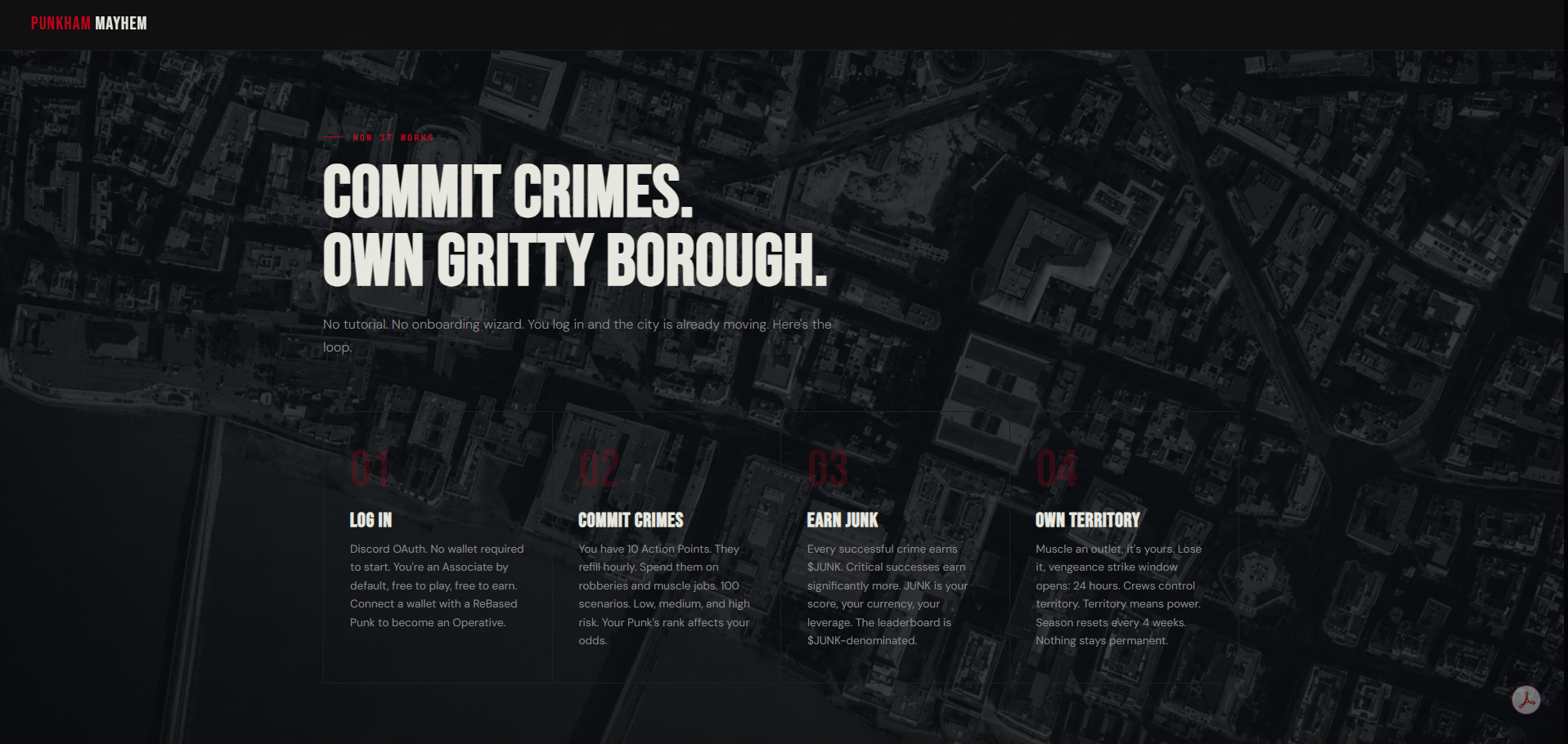
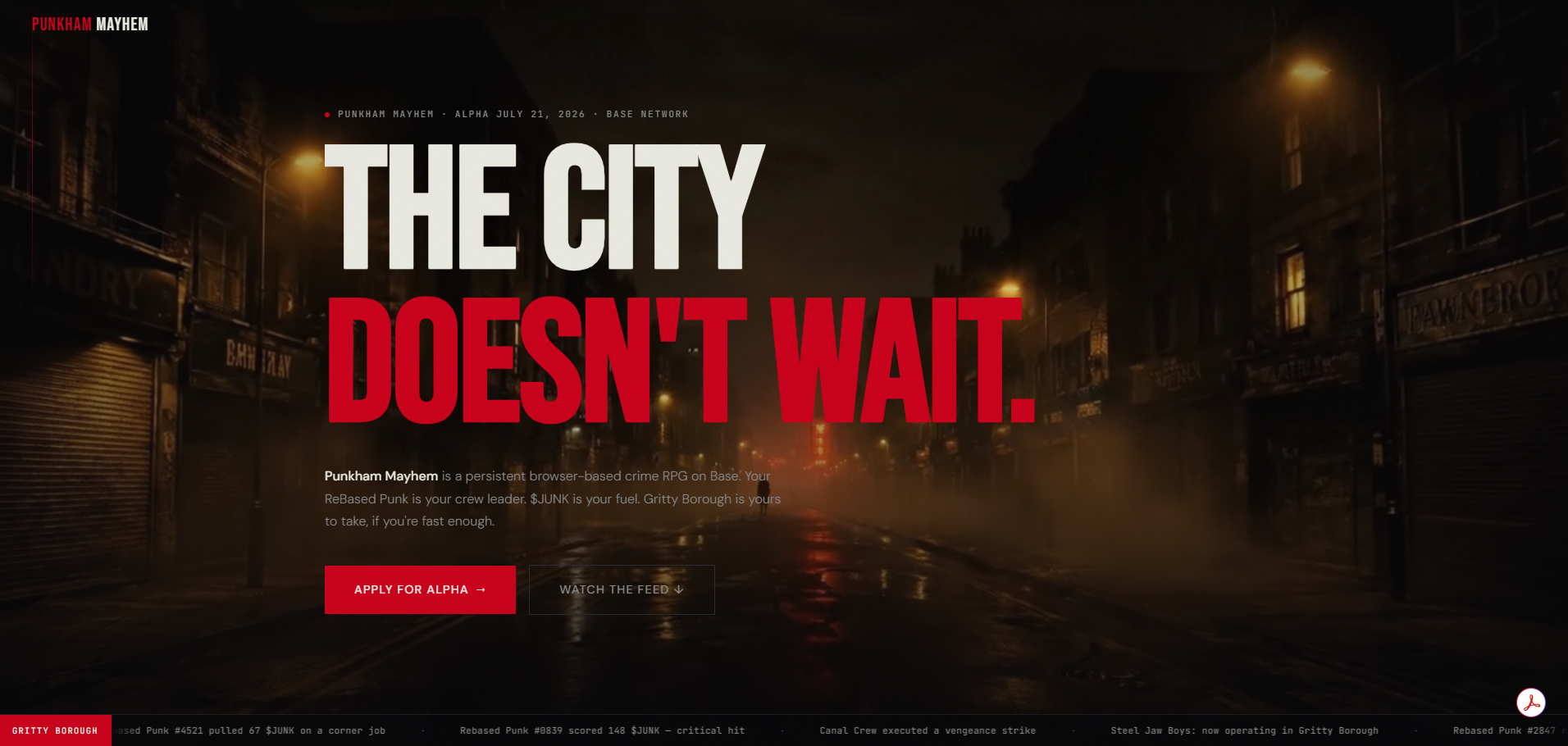
A persistent, browser-based crime RPG - no app download, plays entirely in the browser. Players operate as crime bosses in a shared underworld that keeps running whether they're online or not. Two membership tiers co-exist: free players who sign in with their Discord account, and premium players who link a digital collectible (NFT) for full territory access. A live crime feed and competitive season system give players a compelling reason to return daily.
- Action Point Energy System: Players start each day with 10 energy points. Every crime committed costs points, and they recharge automatically at one point per hour. This controls the pace of play, prevents bots from farming around the clock, and guarantees players have something to look forward to when they return. Each crime resolves against 100 pre-written story scenarios - no two sessions feel identical.
- Territory Control System: Premium members (NFT holders) can seize business locations from the game world or rival players. Controlled locations generate a steady stream of in-game currency (JUNK tokens) passively - meaning premium members earn while offline, creating an ongoing financial incentive to stay active and hold their digital collectible.
- 4-Week Season Leaderboard: Competitive seasons run on 4-week cycles with separate rankings for free and premium players. At season end, top performers receive prize payouts and rankings reset - sustaining competitive tension and giving every player a fresh shot each month.
- Vengeance Window: Players have 24 hours to retaliate after a PvP attack. A "Hospital" recovery state temporarily removes defeated players from competition, giving them time to regroup while preventing discouraging knockout streaks that would cause players to quit.
PunkArcade
Automated Web3 Gaming Platform · Two Live Games · Base Blockchain
The competitive gaming layer of Punkverse - a suite of two live games that run entirely on automated schedules, requiring no admin to operate day-to-day. Both games use the community's in-game currency (JUNK tokens) as the engine for competition and reward. Built on Base blockchain with a PHP/MySQL backend that needs no Node.js runtime or build pipeline to operate.
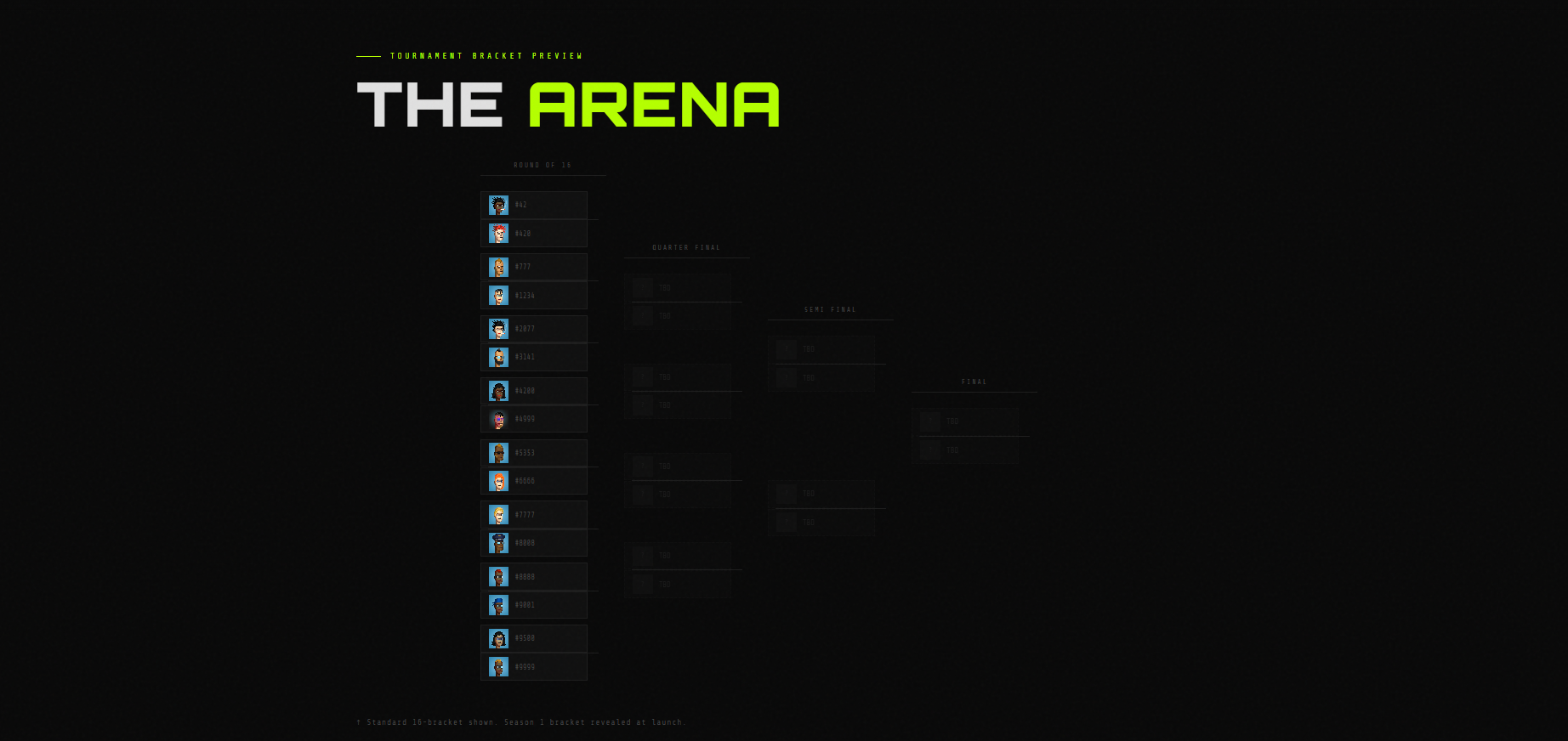
- Showdown - NFT Tournament Bracket Game: Community members vote on head-to-head NFT matchups by staking their JUNK tokens on the outcome. Winners receive a proportional share of the losing side's stakes, while the platform retains a small fee that gets permanently removed from circulation (burned), keeping the token supply healthy. Rounds open, resolve, and pay out on an automated daily schedule - no human needed to run it.
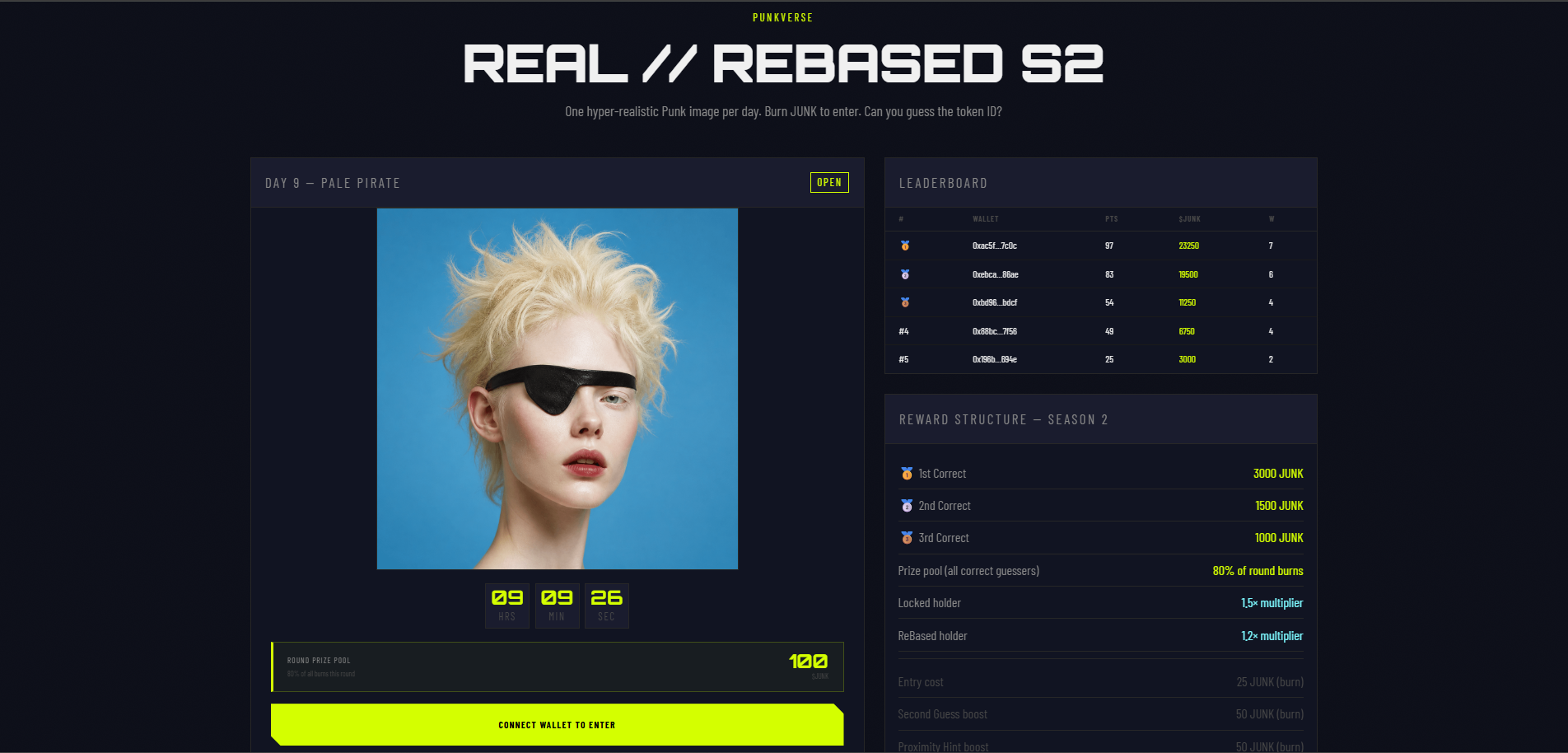
- Real // Rebased S2 - Daily Prediction Game: Players spend JUNK tokens to guess a hidden outcome each day. Correct guesses earn multiplied rewards; NFT holders receive a built-in score bonus. The entire game cycle (opening, closing, revealing, paying winners) runs autonomously on a scheduled timer - fully self-operating with anti-gaming safeguards to prevent abuse.
- Partner Monetization Pipeline: External NFT communities can pay to run their own branded version of the Showdown tournament. They submit their collection details, pay a listing fee and prize pool, and the platform handles everything else - creating a recurring revenue stream that requires no custom development per client.
BTFD Rabbits Staking Platform
Holder Retention & Rewards Platform · Ethereum · Carrot Token Economy
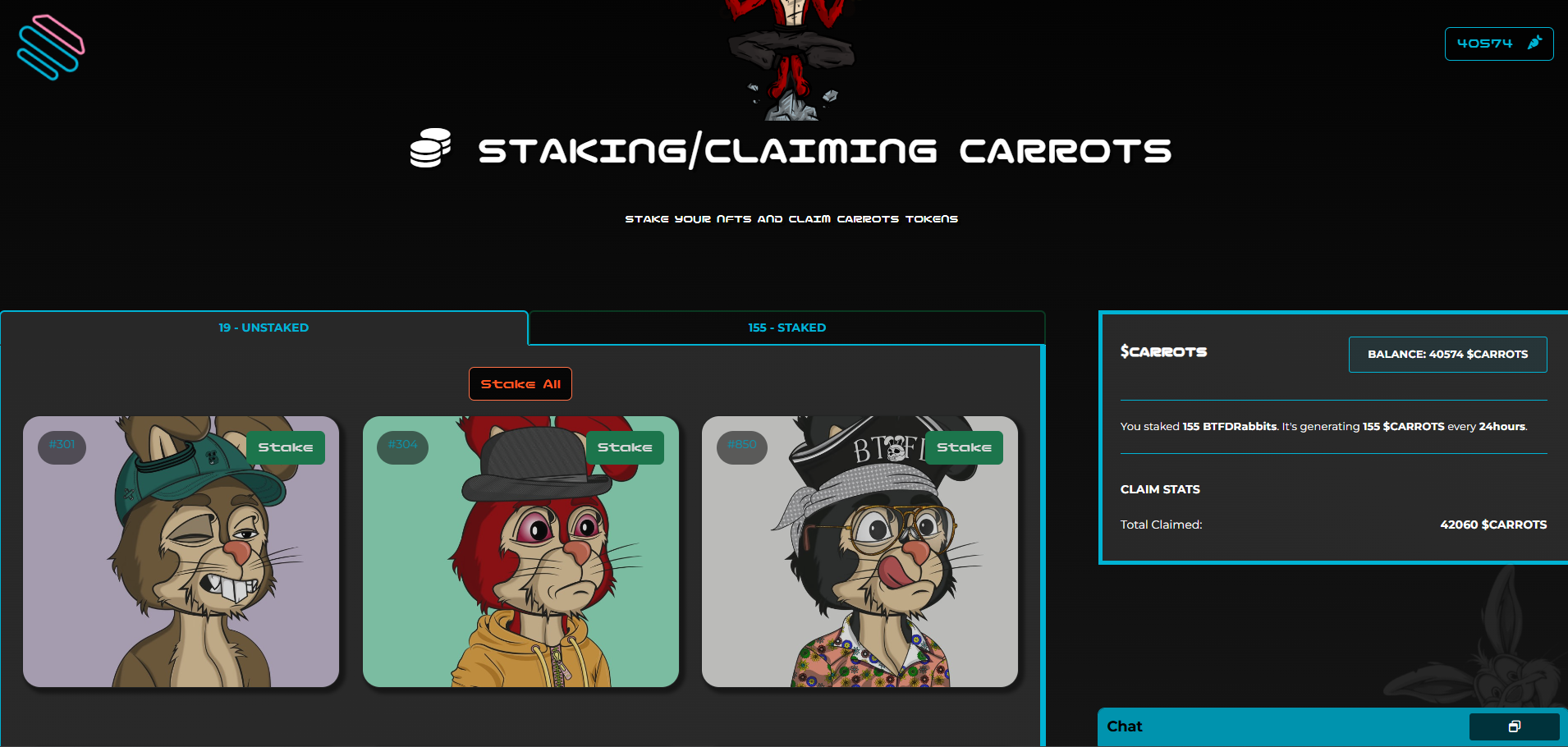
A full utility and retention layer built on top of an existing digital collectible (NFT) community on Ethereum. Holders stake (register) their NFTs to earn Carrot tokens - an internal currency they can spend within the ecosystem. The closed spending economy (marketplace, auction house, prize machine) keeps tokens circulating rather than accumulating, sustaining long-term engagement.
- Anti-Sell Listing Penalty: The platform checks in real time whether a holder's NFT is listed for sale on OpenSea. If it is, that NFT earns zero Carrot tokens. This directly converts the most common churn behavior (listing to sell) into a financial cost - holders who want to keep earning must keep holding. The result: reduced floor sell pressure without any community policing needed.
- Closed Carrot Token Economy: Carrot tokens exist only within the platform - they can't be withdrawn or traded externally. They're earned through staking and spent across three destinations: a peer-to-peer marketplace, a time-limited auction house, and a prize vending machine. Keeping all spending internal prevents token leakage and sustains the value loop.
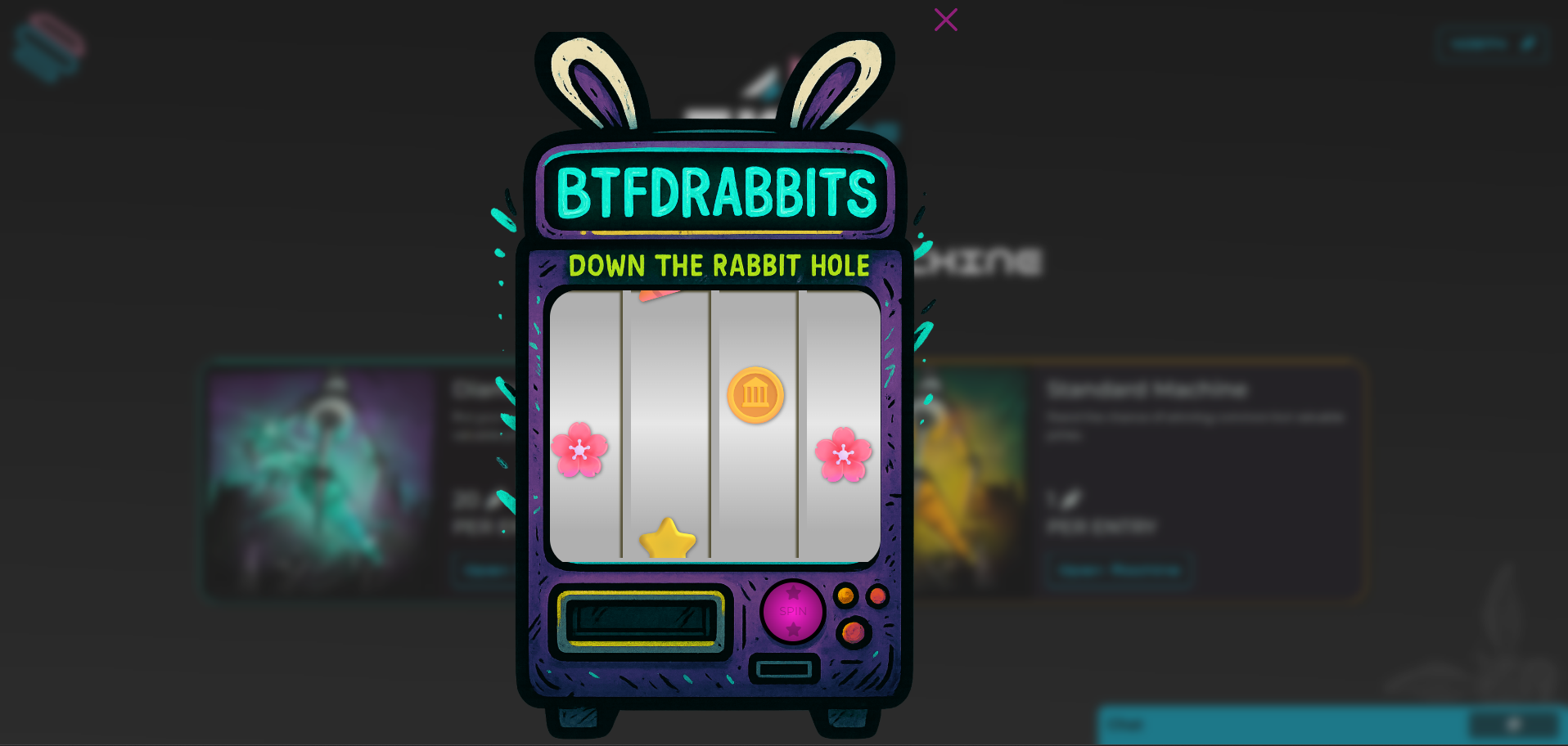
- Prize Vending Machine (Slot Game): Holders spend Carrot tokens for randomized prize draws with configurable reel combinations and prize tiers. Each machine's odds and rewards are admin-adjustable without code changes, allowing seasonal prizes and promotional events to run without developer involvement.
PunkLocker + Punk Power Progression System
NFT Commitment & Progression Infrastructure · Holder Retention Backbone · Base Blockchain
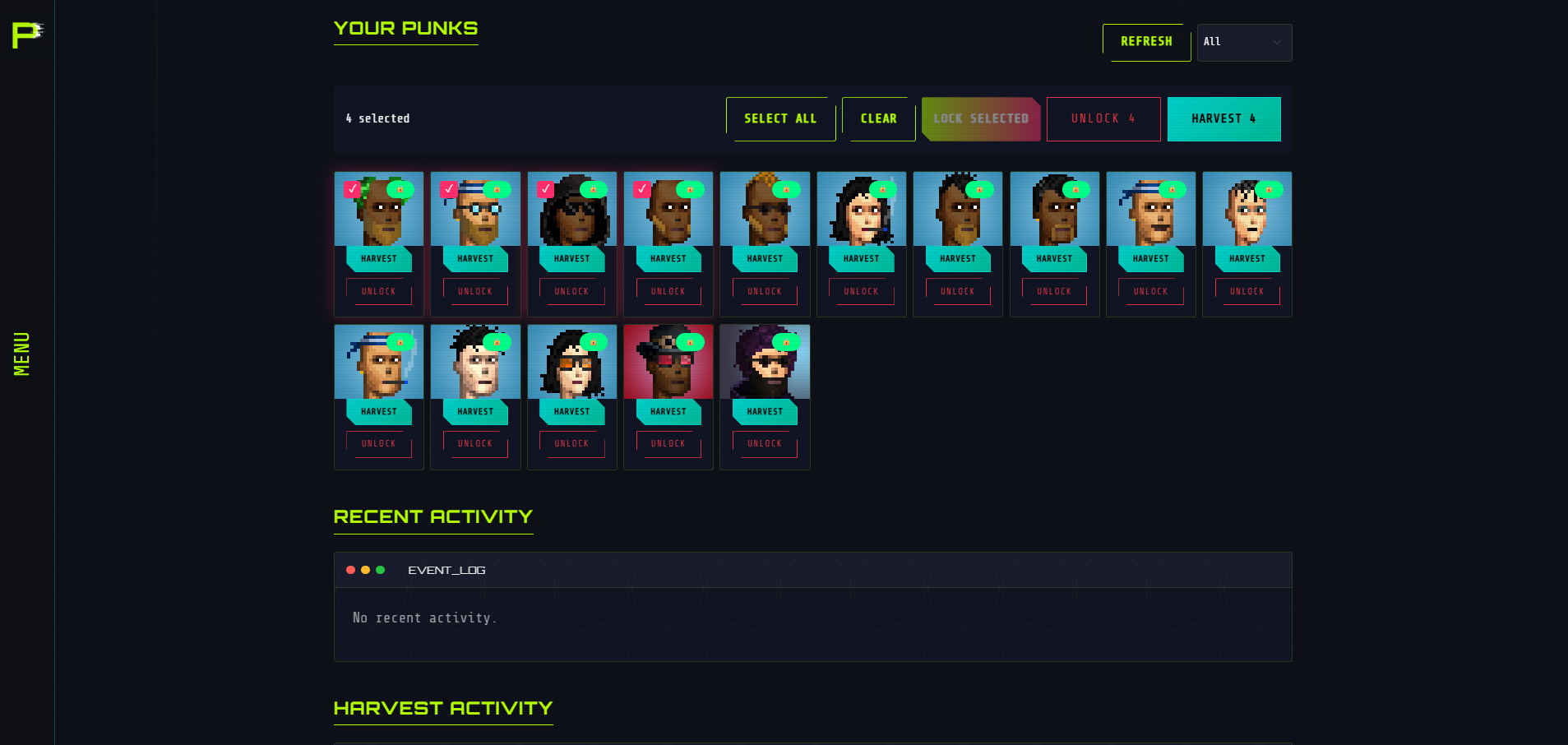
The retention backbone of Punkverse. Holders voluntarily lock (commit) their NFTs into a smart contract vault, which starts accumulating Punk Power (PP) - a loyalty score - automatically over time. The longer a holder locks, the more PP they accumulate. PP can then be harvested (withdrawn) into a spendable balance that unlocks platform features, rewards, and future utilities.
- Time-Based Loyalty Scoring: Punk Power (PP) accrues automatically while a holder's NFT is committed to the vault - no action required. This creates a passive progression system: holders who stay longer accumulate more. An unlock penalty (holders forfeit a configurable portion of PP if they exit early) discourages short-term flipping and rewards patience.
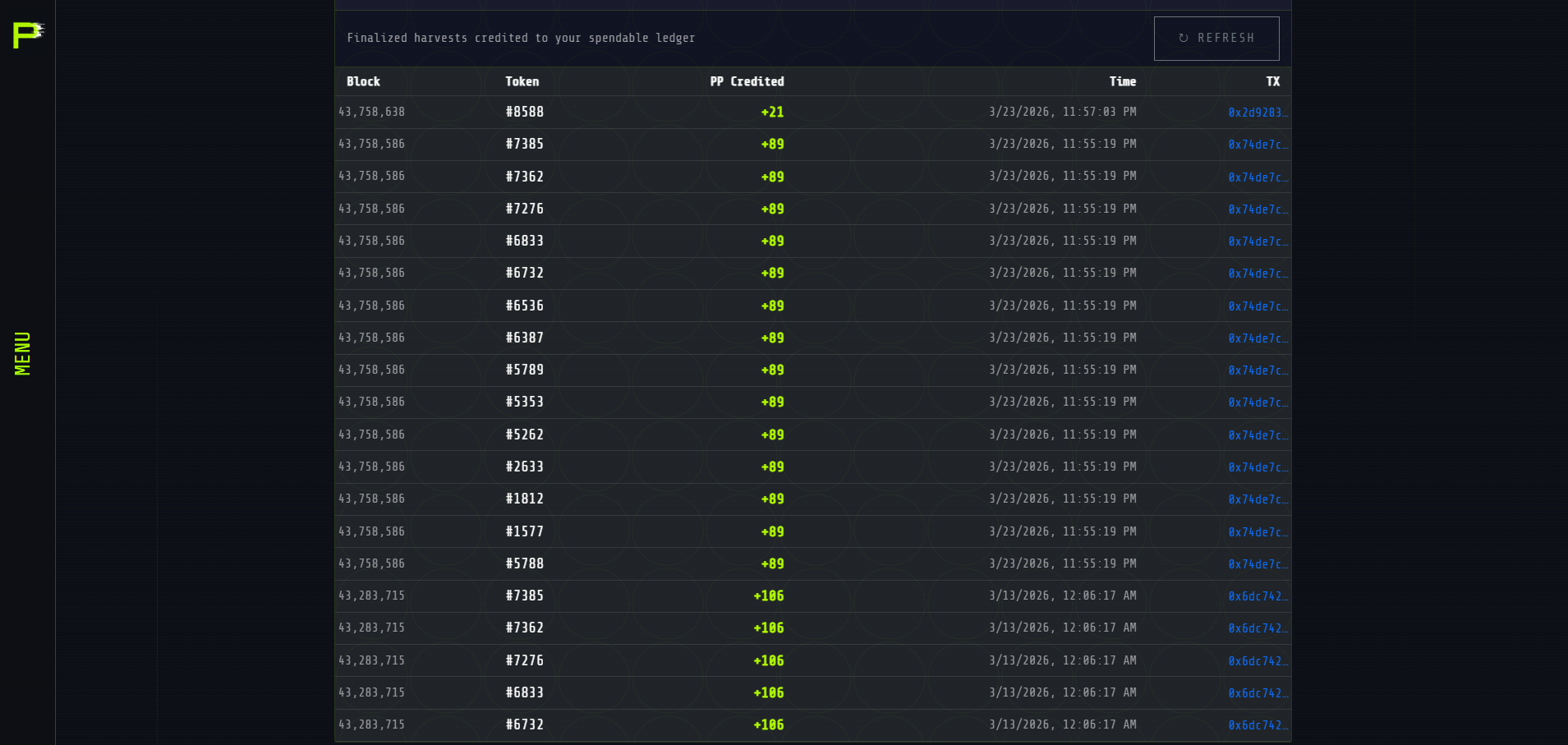
- Secure On-Chain to Off-Chain Bridge: When a holder wants to spend their PP, they trigger a blockchain transaction that permanently converts their on-chain score into a spendable off-chain balance. The system waits for 12 blockchain confirmations before crediting the balance - preventing fraud from chain reorganizations. Once confirmed, the balance is immediately available for spending within the platform.
- Non-Transferable Spendable Balance: The final PP balance lives in a secure database ledger - it cannot be sent to another wallet, withdrawn as cash, or gamed externally. It can only be earned by holding and spent within the ecosystem, keeping utility exclusive to genuine holders and preventing secondary market manipulation.
$JUNK Economy
Deflationary Ecosystem Currency · Blockchain Token + Internal Game Ledger · Base Blockchain
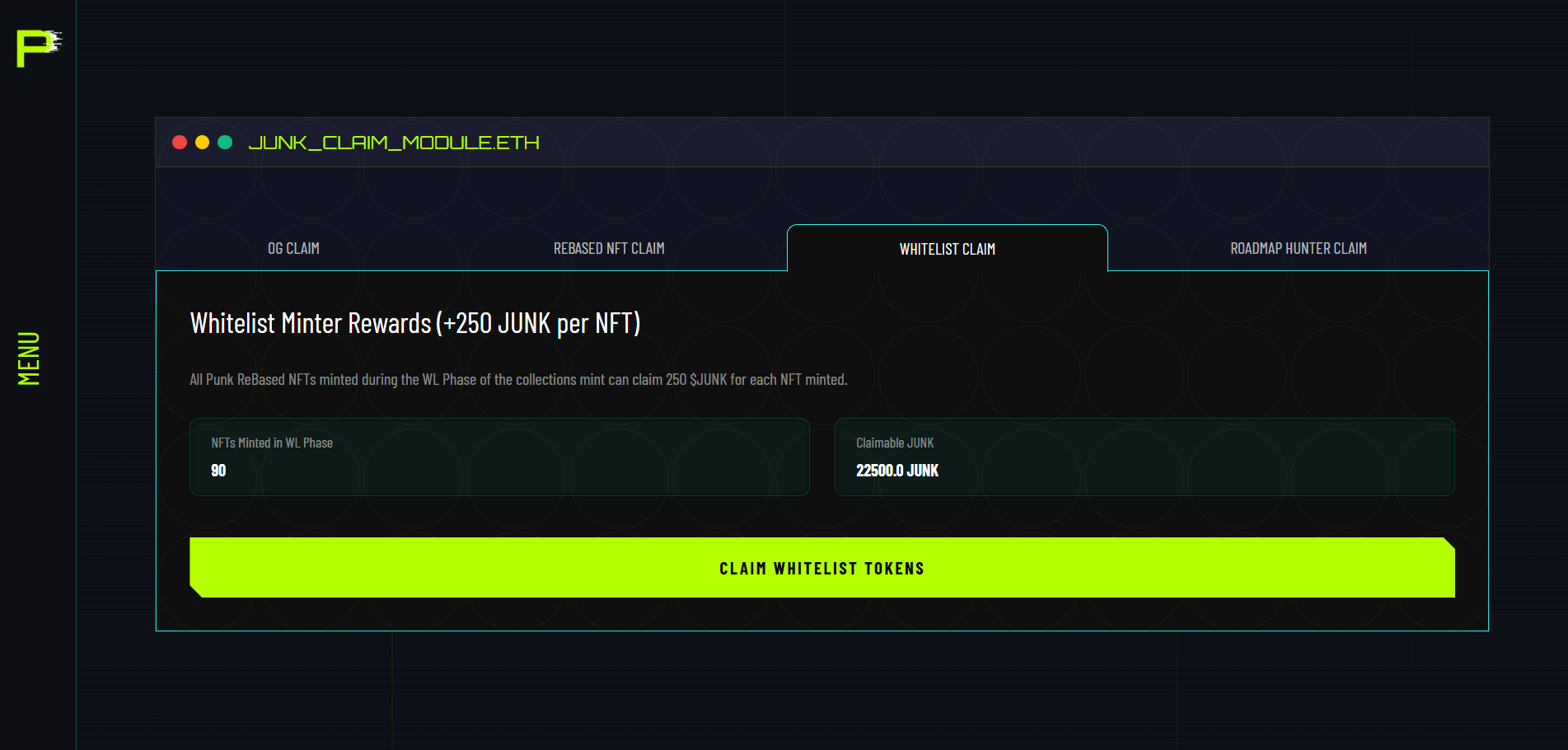
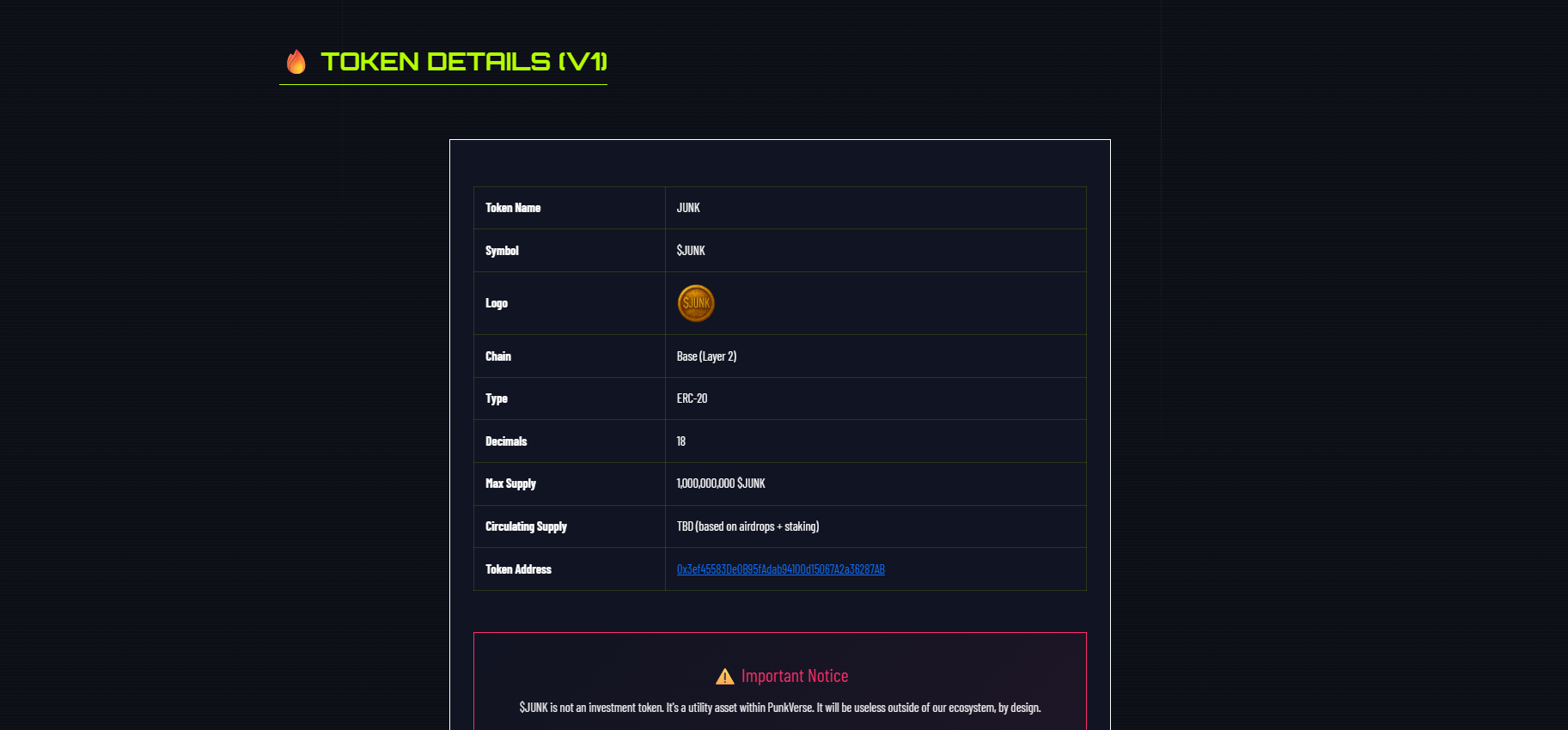
JUNK is a dual-layer currency system: publicly traded on the blockchain for community distribution, and privately tracked in a secure database for in-game spending. Fixed at 1 billion tokens maximum - no new tokens can ever be created. Designed to circulate, not accumulate: every platform interaction that spends JUNK removes some from circulation permanently, keeping the supply healthy over time.
- 5-Channel Token Distribution System: New token holders receive JUNK through five distinct pathways: original community members claim historically owed balances via cryptographic proof, existing NFT holders claim a reward per collectible they own, early mint participants receive a bonus based on how many they minted, community explorers earn tokens for completing hidden challenges, and Discord members receive tokens through timed bot campaigns. Each channel is independently managed and can be toggled without affecting the others.
- Built-In Deflationary Burn Model: Every time JUNK tokens are staked in a game, the platform retains a small fee and permanently destroys (burns) those tokens - they are removed from the total supply forever. Over time, this means more game activity equals less total supply, which creates natural scarcity without requiring artificial price controls.
- Two-Layer Currency Architecture: JUNK exists in two states simultaneously. On the blockchain, it functions as a visible, transferable token that the wider community can see and claim. Inside the platform, it functions as a non-withdrawable game currency stored in a secure database - preventing gaming the system by withdrawing and re-depositing tokens for advantages. Both layers are synchronized, but spending only occurs through the platform layer.
The Secret World
Persistent Idle Game World · NFT Utility Platform · Ethereum
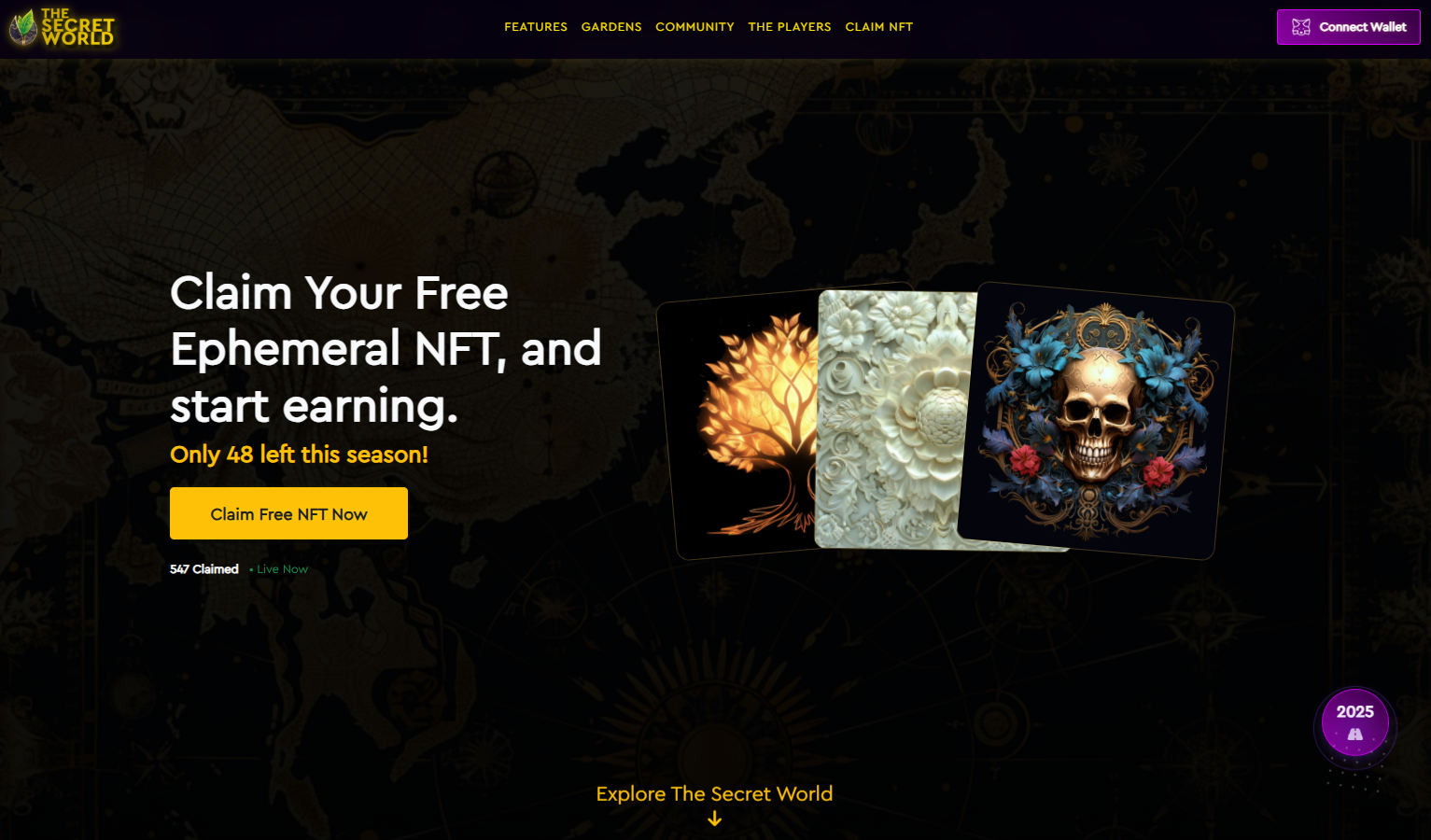
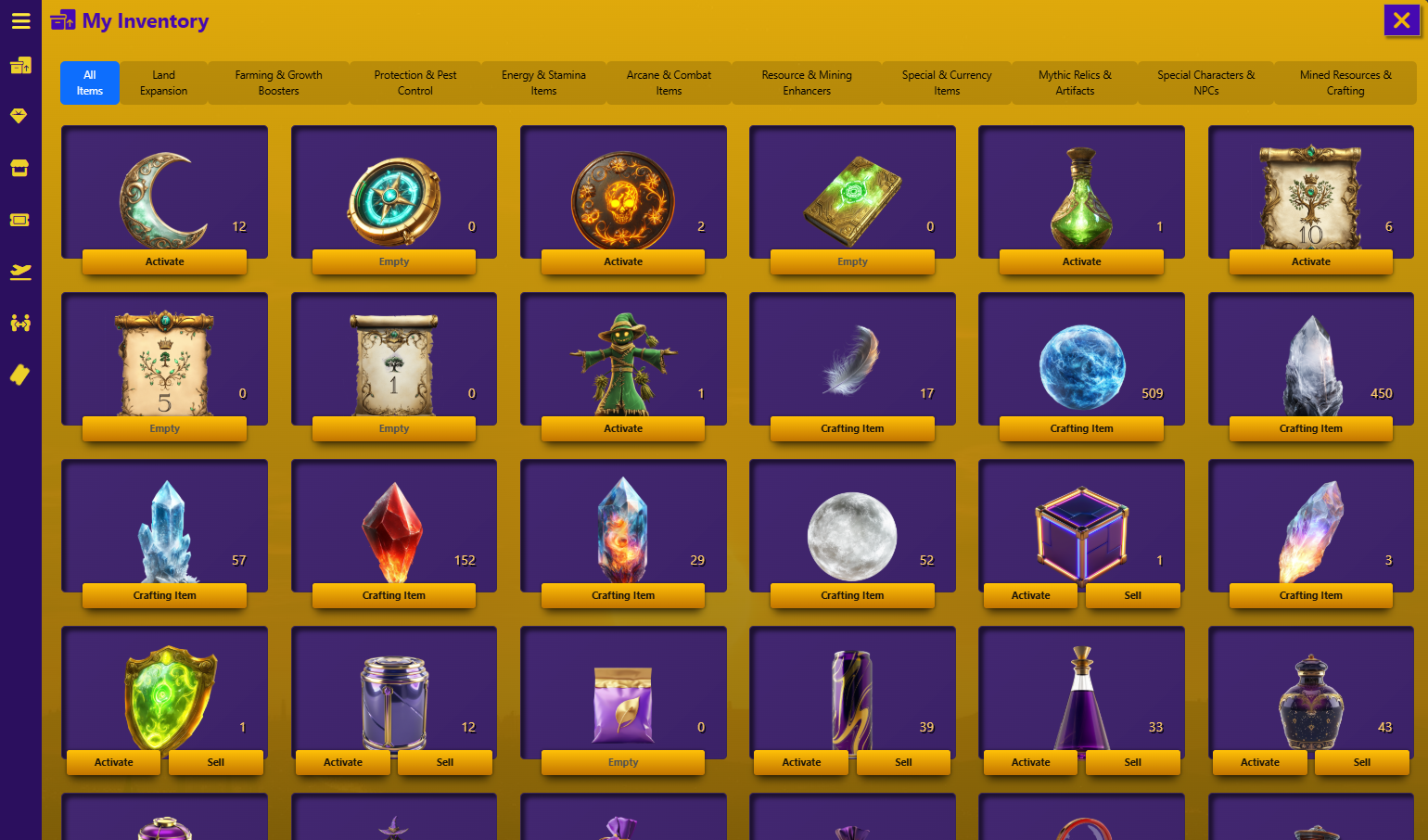
A web-based game world that runs continuously whether players are logged in or not, built for a 555-item digital collectible community on Ethereum. Players plant resources that grow over time, harvest rewards when they return, and reinvest into the next cycle - a loop that rewards consistent check-ins without demanding constant attention. Eight mini-games and a community governance layer extend session depth beyond the core loop.
- Three-Tier Currency Ladder: The economy uses three currencies: Petals (common, earned frequently), Seeds (mid-tier, 100 Petals = 1 Seed), and FruitGems (premium, 100 Seeds = 1 FruitGem). Each tier unlocks a progressively different set of features and content - players start with accessible low-tier activities and naturally progress toward higher-value experiences over time, extending the engagement arc across weeks rather than hours.
- Ephemeral Yield-Generating Assets: Free temporary assets (no purchase required) can be planted in the game world. Each has a fixed growth cycle - it generates yield while it grows, then expires and is permanently removed from the game. This creates a natural free-entry loop that keeps new players engaged while also creating an ongoing supply of limited-time assets that drives scarcity and repeat interaction.
- Player-Governed World Rules: The Verdanthian Congress is an in-game governance system where the player community votes to shape world mechanics - which mini-game rewards are active, how currency rates adjust, and which events run. This shifts operational decisions from the development team to the community, reducing admin overhead while increasing community investment and ownership.
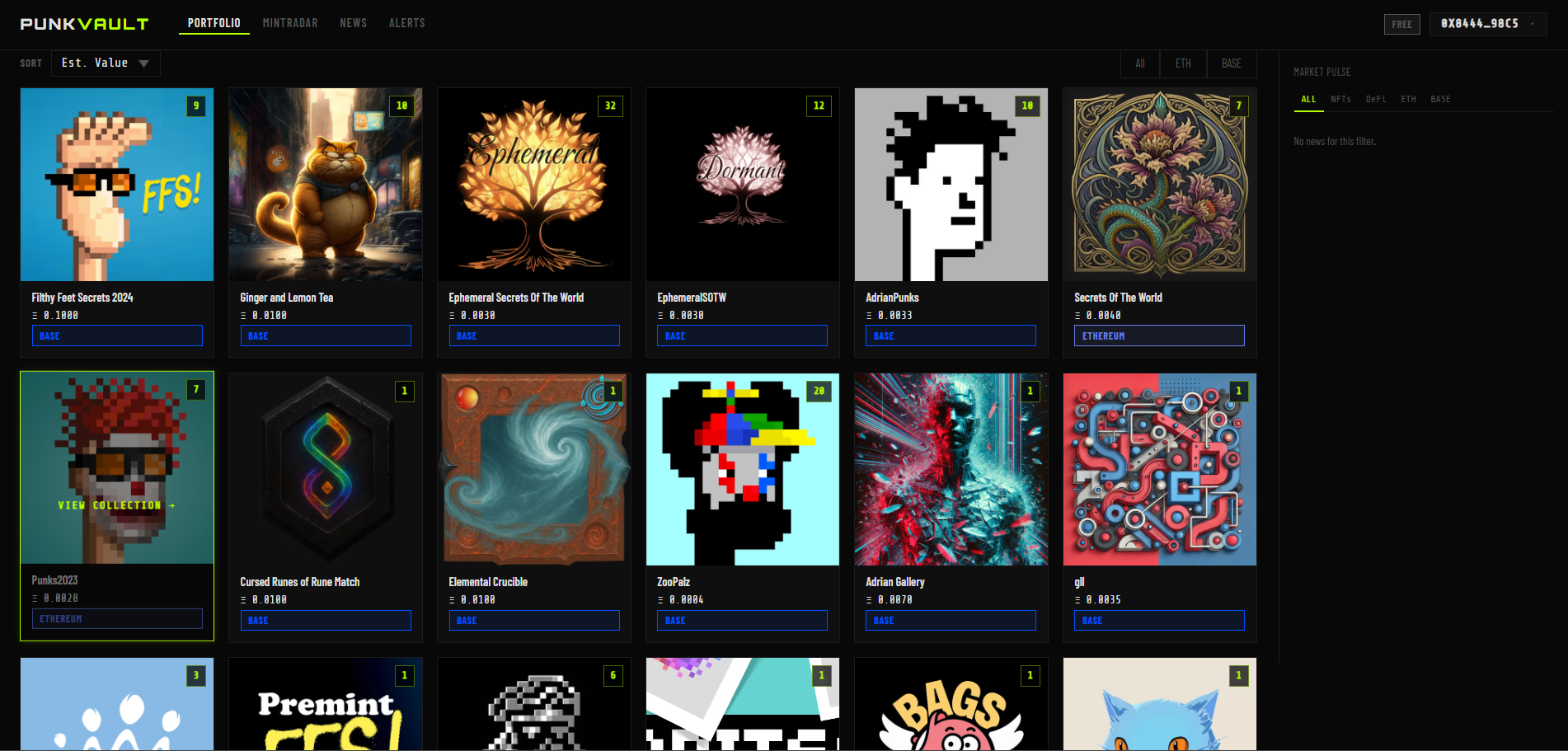
PunkVault
NFT Holder Intelligence Dashboard · Community Analytics · Base & Ethereum
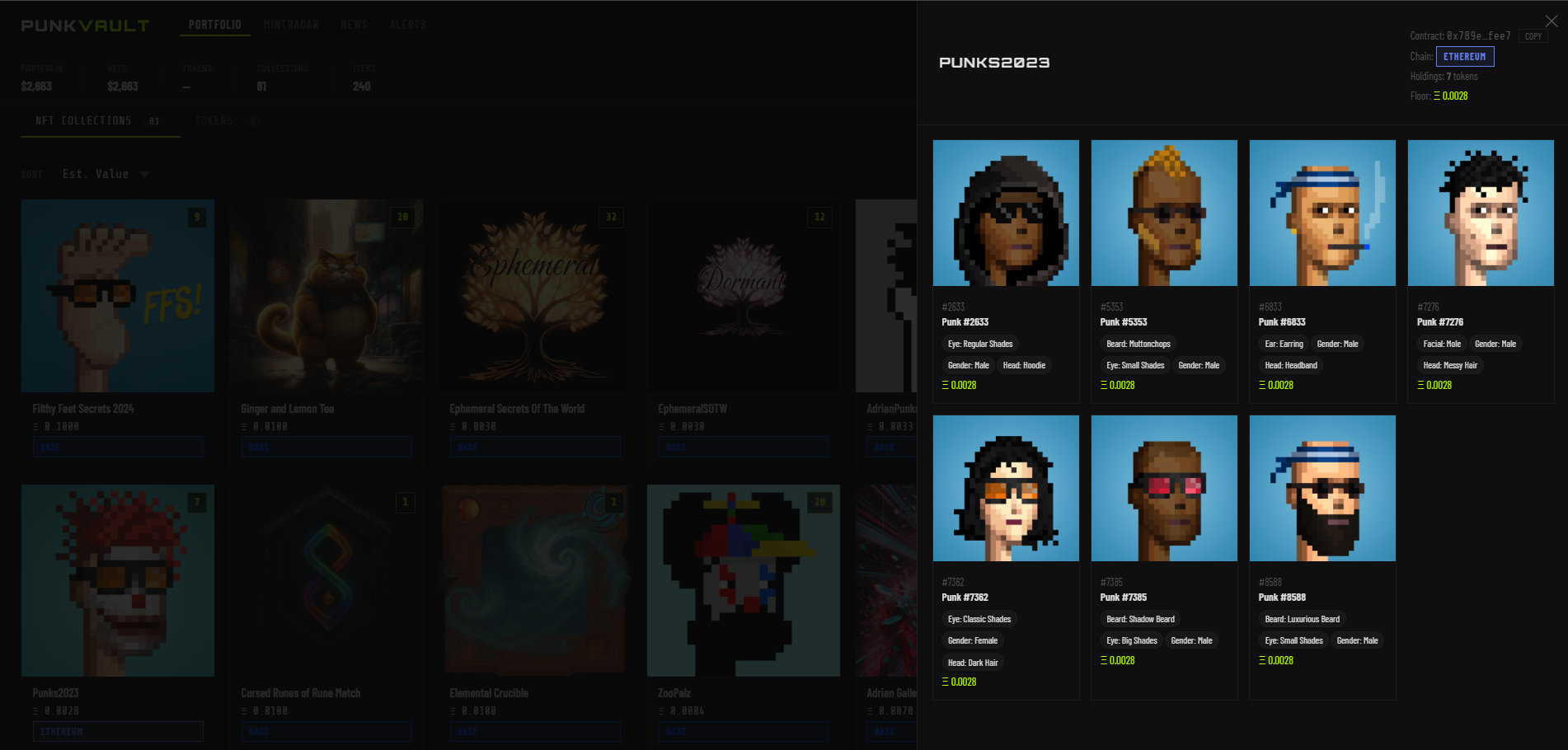
A wallet-connected analytics platform that gives ecosystem operators a real understanding of who their holders are and how they behave - not just wallet addresses, but behavioral segments, portfolio history, and activity patterns across multiple blockchains. Architecture and data pipeline fully designed; build in progress.
- Holder Segmentation by Behavior: The system categorizes holders into tiers based on portfolio composition, transaction history, and activity signals - distinguishing between long-term committed holders, recent buyers, and inactive wallets. This enables targeted engagement campaigns: rewarding loyal holders differently from newcomers, or re-activating inactive segments with tailored incentives, without manual analysis.
- Historical Portfolio Replay: Operators can view a holder's portfolio value and composition at any point in the past - useful for determining eligibility for retroactive rewards, auditing loyalty milestones, or understanding how holder behavior changed around specific events. Trade history is indexed continuously across Base and Ethereum.
Modular NFT Gaming System
Reusable Web3 Game Framework · Add Features Without Rebuilding · Multi-Blockchain
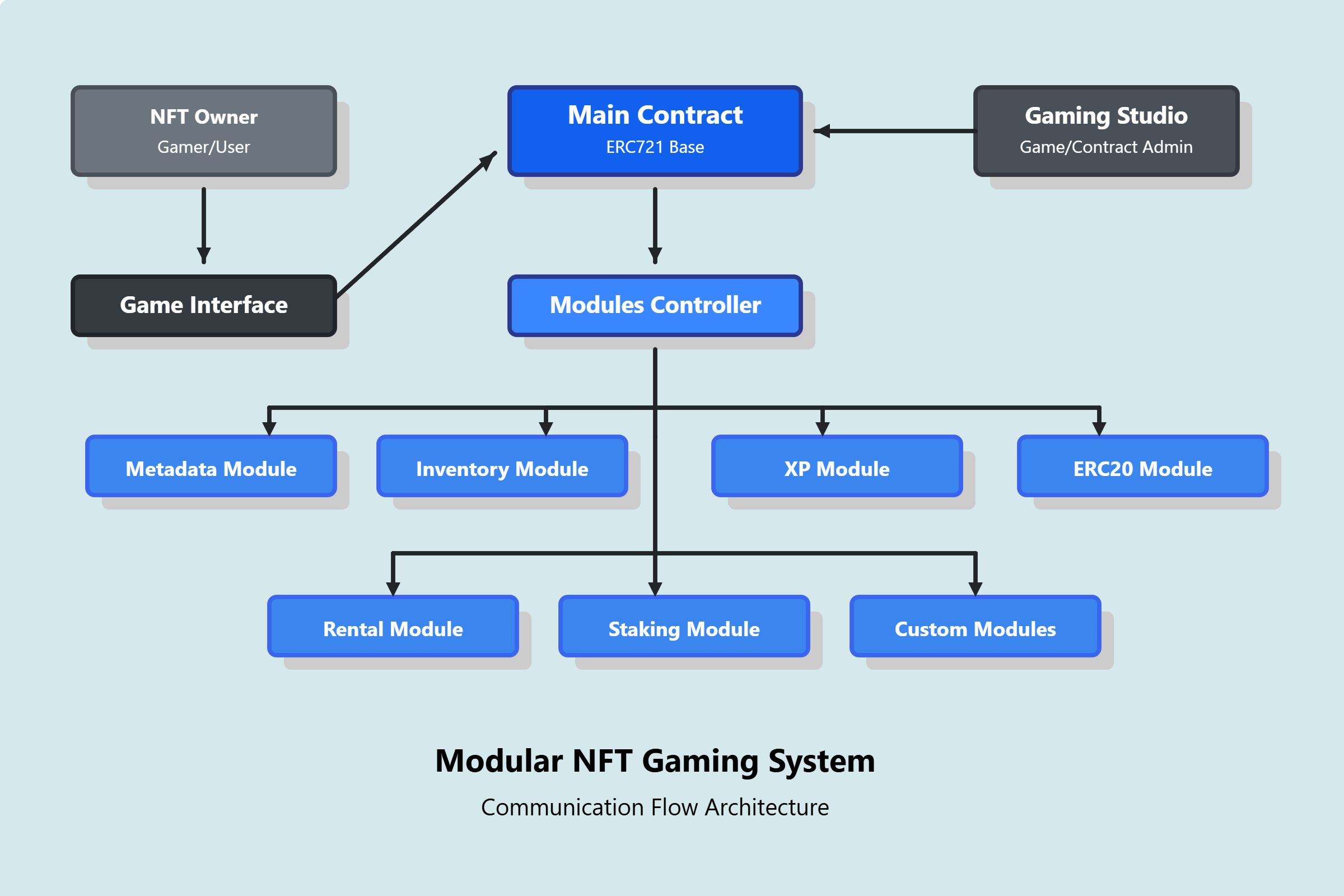
A plug-and-play smart contract framework that lets Web3 gaming studios launch with a core NFT system and add new features - experience points, inventory, staking, rentals - without rewriting existing contracts. Built to solve the most common Web3 gaming engineering problem: needing to deploy an entirely new contract every time the product evolves. Features connect as independent modules that can be swapped or upgraded independently.
- Swappable Feature Modules: The system separates game features into independent modules - Player Profiles, Inventory Management, Experience Points (XP), In-Game Currency, Asset Rental, and Staking - all connected to the core NFT contract through a central controller. Adding or replacing any module doesn't require touching the core contract, eliminating the risk and cost of redeployment for every product update.
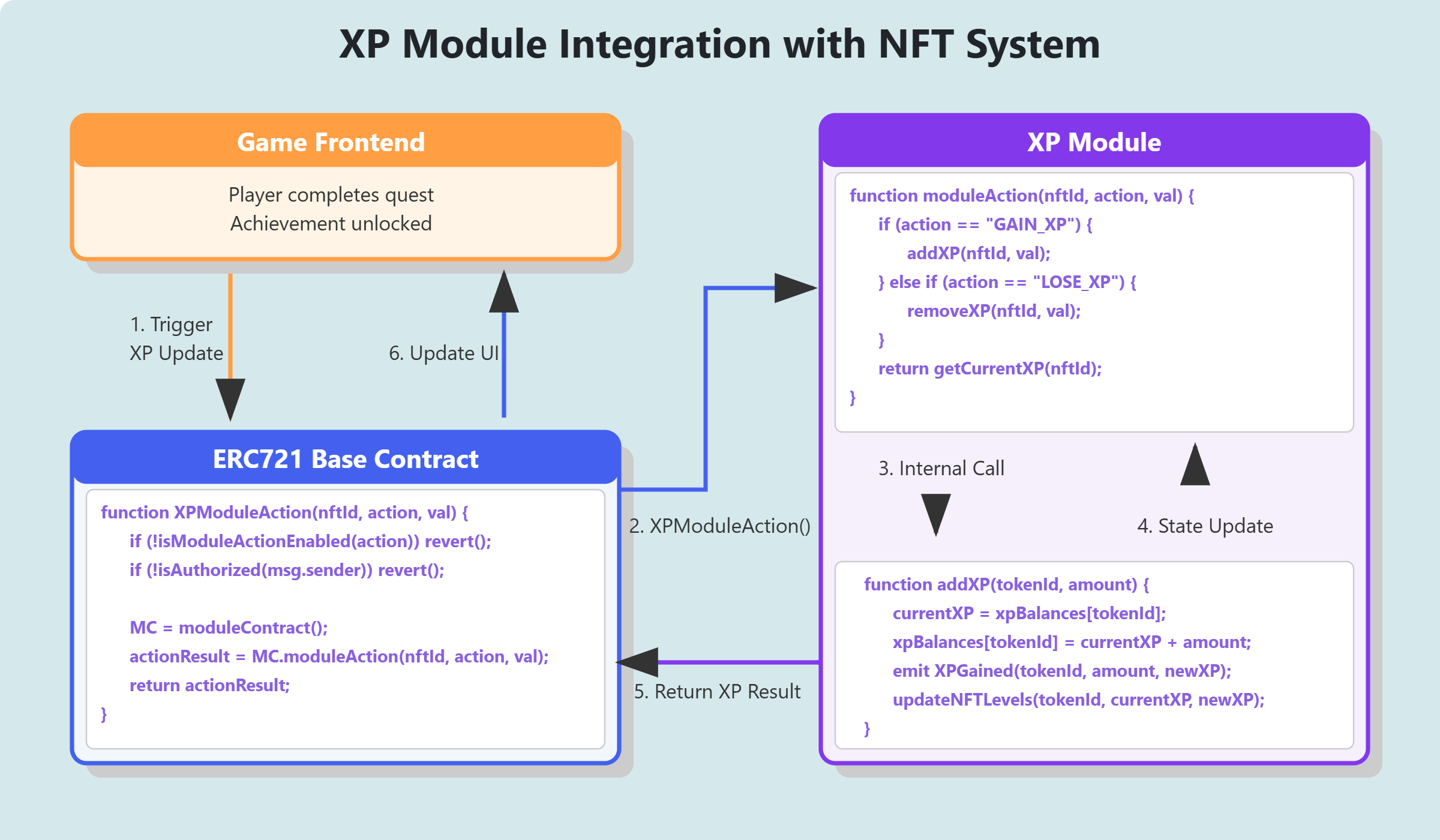
- On-Chain Experience Point (XP) System: Each NFT tracks its own experience point balance directly on the blockchain. When a player completes an in-game action, the frontend signals the NFT contract, which updates the XP record and returns the result to the interface - the entire flow visible and verifiable on-chain. This makes progression provably fair and independently auditable.
- Royalty-Enforced Multi-Chain Deployment: The framework includes cost-efficient upgrade patterns that reduce blockchain fees on each contract update, built-in creator royalty enforcement that automatically routes a percentage of every secondary sale to the creator, and a deployment pipeline that works across multiple blockchains from the same codebase.
Decentralized NFT Marketplace
Trustless NFT Trading Platform · Automatic Royalties · 10 Blockchains
A smart-contract-based NFT trading platform where buyers and sellers transact directly - no intermediary holds the assets. Every transaction enforces creator royalties automatically at the contract level, without relying on marketplace goodwill. The platform reads live pricing from blockchain oracles for accurate USD conversion, and the entire architecture is deployable across ten EVM-compatible blockchains from a single codebase.
- Trustless Escrow via Smart Contract: When a seller lists an NFT, it transfers into a neutral smart contract - neither party controls it. When a buyer completes the purchase, the contract simultaneously delivers the NFT to the buyer and the payment to the seller in a single atomic transaction. If anything fails, both parties automatically receive their assets back. No platform can interfere, delay, or freeze the trade.
- On-Chain Royalty Enforcement: Creator royalty percentages are written into the contract at deployment. Every secondary sale pays out the specified royalty to the creator's wallet automatically - no manual claim, no opt-out for marketplaces. This eliminates the problem of platforms choosing to ignore royalties that has become widespread in the NFT space.


Punkverse Block Defense
12-Level Tower Defense Campaign · Server-Side Score Verification · PHP/MySQL
A complete browser-based tower defense game with a 12-level campaign, full world lore, and a server-authoritative scoring system that reconstructs and validates every score server-side - preventing client-side manipulation. Playable entirely in the browser with no installation.
- Server-Side Score Reconstruction: Every game action is logged and timestamped server-side. At session end, the server independently replays the action log to verify the submitted score is achievable - any discrepancy flags the submission as invalid. This prevents score tampering at the client level without requiring blockchain transactions.
- 12-Level Campaign with World Lore: Each level is tied to an original narrative drawn from the Punkverse world lore. Story progression unlocks between levels, giving players a reason to complete the campaign beyond the score loop. Difficulty scales across three acts with new tower types, enemy variants, and map layouts introduced at each act transition.


Technical Stack
Built to Last.
Deployed to Run.
- PHP 8.x - server-side game logic, API endpoints, cron automation, authentication flows
- MySQL - relational game state: player records, economy ledgers, event logs, season data
- REST API architecture - clean separation between client and server with consistent response contracts
- Scheduled task automation - game events, reward cycles, and season resets run on timers with no manual trigger
- Session-based authentication with abuse prevention - one-time tokens, rate limiting, request validation
- AJAX-based backend dispatcher - single entry point for all client requests, clean separation of concerns
- No npm. No node_modules. Zero supply chain exposure - the entire stack ships as PHP files on standard hosting.
- ethers.js v6 - wallet connections, reading blockchain data, executing transactions from the browser
- Wallet message signing - users prove wallet ownership without sending a transaction or paying fees
- Token standards: fungible tokens (ERC-20), collectibles (ERC-721), semi-fungible (ERC-1155)
- Cryptographic distribution proofs - verifiable token claim eligibility without storing all wallets on-chain
- Blockchain event monitoring - detects on-chain activity and triggers off-chain database updates automatically
- Discord OAuth login - players sign in with Discord before connecting a wallet, reducing friction dramatically
- Internal token ledger design - database-backed economies that behave like blockchain tokens without gas costs
- Engagement loop architecture - lock → earn → spend → burn → reward cycles that compound over time
- Season lifecycle management - automated 4-week competitive cycles: open, run, reward, reset
- Anti-abuse and rate limiting - server-side enforcement that prevents exploitation of game economies
- Deflationary economy design - supply/demand balance through spending sinks and controlled burn
- NFT-gated access control - feature tiers unlocked by digital collectible ownership, verified on-chain
Approach
Why Communities Stay -
And Why They Leave.
Retention Is an Engineering Problem
Getting people in is marketing. Keeping them in is architecture. Most Web3 projects spend heavily on launch and nothing on the systems that make holders return on day 30. I specialize in the second problem: the daily reason to come back, the progression that feels earned, and the economy where selling early costs more than staying.
Systems Compound. Features Don't.
A new feature entertains once. A well-designed system compounds. I build loops where each action feeds the next - hold to earn, earn to spend, spend to burn, burn to sustain scarcity, scarcity to hold. The automated game timer runs at 2am. The economy rebalances itself. Nobody needs to be watching for it to work.
Honest About What I Build
My ecosystems are indie-scale - two collections of 10,000 digital collectibles each. I don't claim otherwise. What I can demonstrate is that the systems work at the mechanics level: the economies hold, the loops sustain engagement, and the architecture transfers directly to larger projects. The PHP/MySQL stack is a deliberate choice - it ships faster, runs reliably on standard hosting, and carries zero npm dependency risk. No supply chain to compromise. No node_modules to audit. The attack surface is the server, not a thousand packages you didn't write.
About
Solo Founder.
Systems Engineer.
15 Years Shipping.
I'm Chris Nwasike - Lagos-based full-stack engineer, operating publicly as ChrisDBuilder. I took over a struggling digital collectible project mid-lifecycle, diagnosed the real problem (no retention infrastructure, only launch energy), and rebuilt it around systems that sustain communities: holder commitment mechanics, an automated game platform, token economies with built-in supply control, and a seasonal game engine that runs itself.
Alongside my own projects, I build engagement and retention systems for external Web3 clients - staking platforms, reward engines, game economies, and marketplace infrastructure. My technical stack is PHP, MySQL, and JavaScript, with direct blockchain integration through ethers.js. I connect to and interact with smart contracts; I don't write the contracts themselves. That's an honest technical distinction and I'll always name it upfront.
I'm not a contractor-for-hire who takes briefs and delivers code. I'm an operator who understands the product layer well enough to own it - strategy, architecture, build, and deployment - solo when needed.
Scheduled Automation · Auth Systems
ethers.js v6 · GSAP · Canvas2D
Distribution Proofs · Event Monitoring
Wallet Auth · Base / Ethereum
Economy Architecture
Seasonal Systems · Abuse Prevention
Let's Build
Your Community Is Active at Launch.
The Question Is: What Keeps Them After?
If you're working on a Web3 gaming platform, NFT ecosystem, or digital collectible community and you need the systems that sustain engagement - not a marketing campaign, not a Discord giveaway, but actual retention infrastructure - let's talk about what I can build for you.